
Google’s AI Content Crackdown: What September’s Rankings Are Telling Us
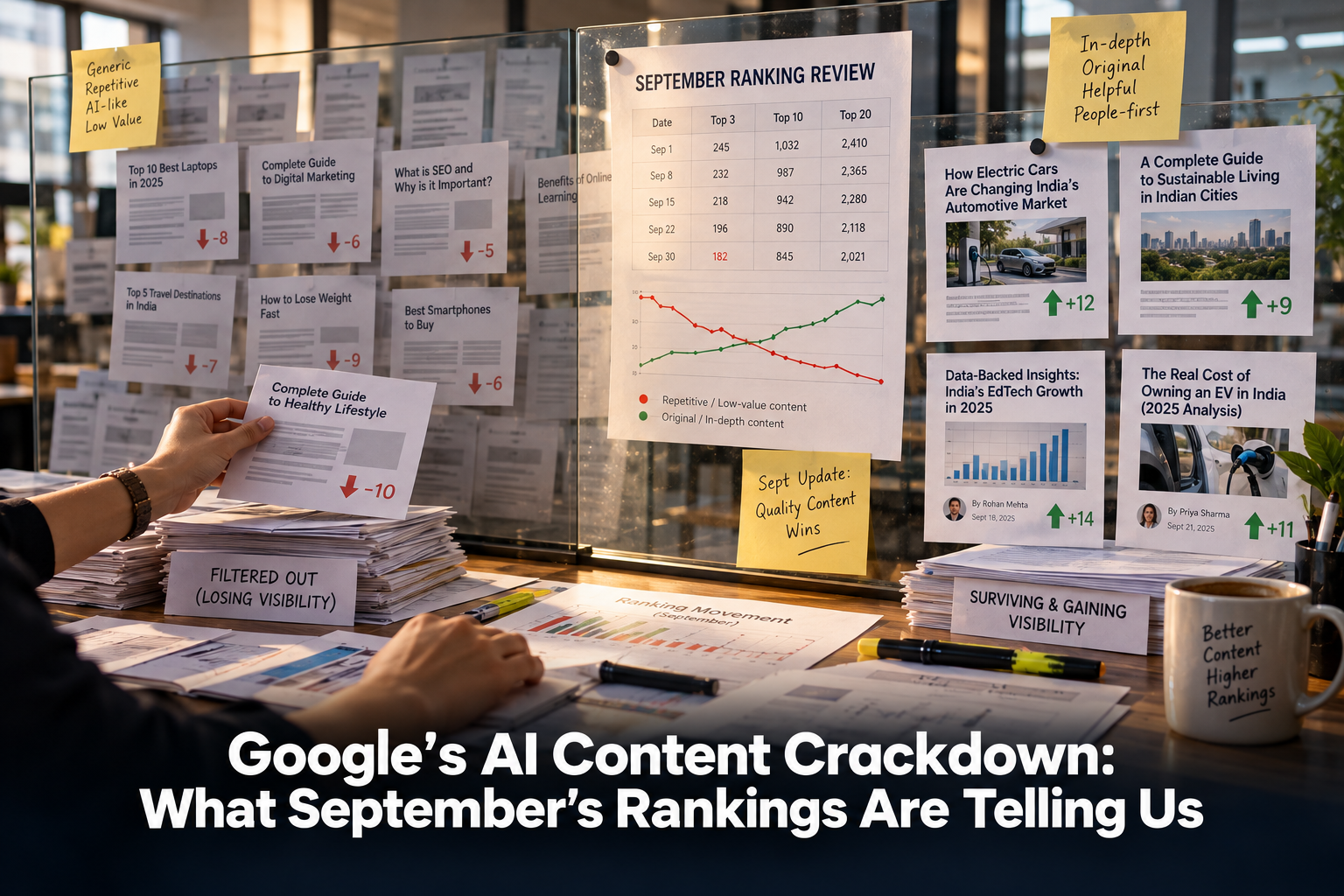
Google’s AI Content Crackdown: What September’s Rankings Are Telling Us Google’s AI content crackdown became one of the most talked-about…

Your SEO strategy probably has a publishing problem, and it’s not what you’d expect. Most businesses assume that publishing more content means better rankings, more traffic, and stronger authority. The logic seems obvious — more pages means more chances to rank, more keywords covered, and more reasons for Google to pay attention. For years, that approach worked reasonably well. Content teams set monthly targets, blogs went out like clockwork, and the volume kept climbing. But the data from 2026 tells a very different story. Businesses that publish less, but publish better, are outperforming those chasing volume by a significant margin. Google’s algorithms have matured to the point where a website full of thin, average content is now a liability rather than an asset. The shift is one of the most counterintuitive things happening in SEO right now, and most businesses are still operating on assumptions that no longer hold. Understanding what changed, what the data actually shows, and what your content strategy needs to look like going forward could completely change how you approach your publishing calendar — and your results.
Google has a crawl budget. On a site loaded with thin or outdated content, crawlers spend time on weak pages instead of your strongest ones. Every low-quality page your website carries is quietly competing for the same crawl attention as your best content. Google doesn’t know which pages you’re proud of and which ones you published just to hit a monthly target. It has to figure that out by crawling everything. When your site is full of thin, outdated, or duplicated content, Google spreads its attention too thin, and your strongest pages pay the price. Google’s algorithms favour quality, user-focused, authoritative content — not just new content. Publishing without reviewing what you already have creates clutter that slows growth rather than boosts it.
This is not just a theory. The numbers back it up. A case study published by SEO Copilot documented what happened when a brand pruned a large percentage of its indexed pages — clicks and impressions jumped 30% within weeks, and four months later the site ranked for roughly double the number of keywords in the top three positions. Insightsavvys documented a 32% organic traffic boost through a focused content reduction strategy. A Userpilot case study found that deleting nearly 25% of its content led to its highest-trafficked month on record. These are not edge cases. They represent a pattern emerging across industries in 2026 — the sites that clean up their content libraries are pulling ahead of the ones still racing to publish more. In a notable LinkedIn B2B case study, marketing teams audited their archives and removed or merged 847 underperforming blog posts, slashing 23% of their total content footprint, with the result being a major organic recovery as Google focused only on high-value URLs.
Every retained piece of content should serve a clear purpose within the buyer journey — whether educational, commercial, transactional, or support-oriented. That is the filter your content library needs right now. Go through every page on your website and ask honestly: does this page earn its place, or does it exist because someone on the team published it once and nobody reviewed it since? Pages with minimal traffic, no conversions, outdated information, or topics that no longer align with your business are dragging your SEO strategy down. The goal is not to strip your website bare. It’s about amplifying value — the pages that remain carry more weight, attract higher-quality traffic, and drive better results.
Not every underperforming page deserves to be deleted. Your SEO strategy needs a framework for making these decisions. Pages that once ranked well but have slipped are candidates for updating and refreshing rather than removing. Pages that cover the same topic as another stronger page are candidates for merging. Pages with zero traffic, no backlinks, and no clear strategic purpose are candidates for removal. Your site needs at least 6 to 12 months of published content before pruning makes sense — newer posts need time to gain traction, so don’t make decisions too early. Once you have that age and data, set a review cadence. Every 6 to 12 months works for most sites. If you publish multiple posts per week, aim for every 3 to 6 months instead.
Publishing less content is not just an SEO play anymore. It directly affects how AI tools like ChatGPT, Perplexity, and Google AI Overviews understand and represent your business. AI systems pull from your strongest, clearest, most authoritative pages. A website full of thin content creates noise that makes it harder for AI to identify what your business actually stands for. The defining 2026 shift is that SEO outcomes now come from a broader credibility economy. AI compresses the space for generic content while raising the payoff for content with proof, voice, and connected distribution. A leaner, higher-quality content library does not just help your Google rankings. It makes your website easier for AI systems to understand, cite, and recommend.
There can be a brief dip when you remove or consolidate pages, but the data consistently shows recovery and improvement within weeks to months. Some temporary fluctuations are normal, but traffic stabilises and often improves once your site becomes cleaner and more efficient.
Start with pages that have had zero or minimal traffic for six or more months, no backlinks, and no strategic purpose in your buyer journey. Use tools like Ahrefs or Semrush to pull the data and sort by traffic and links before making any decisions.
It depends on the page. If the page has backlinks pointing to it, redirect it to the closest relevant page. If it has no backlinks and no traffic, deleting it entirely is usually the right call.
Every 6 to 12 months works for most sites as routine maintenance. After a Google core update causes traffic drops, a content audit should be the first thing you run.
Not immediately. New websites need to publish consistently to build topical authority first. Content pruning becomes relevant once you have a library large enough to contain underperforming pages worth removing.
The idea that more content always means better SEO results is one of the most persistent myths in digital marketing, and the data from 2026 is dismantling it clearly. Your SEO strategy gets stronger when every page on your website earns its place. Businesses that audit, prune, and focus on quality over volume are seeing real results — more traffic, better rankings, and stronger AI visibility — while those still chasing publishing targets are quietly falling behind. If you want help auditing your content library and building an SEO strategy built for how search actually works in 2026, Turnihi Tech Solutions works with businesses to cut what’s holding them back and strengthen what actually drives results.
Share Post:

Related Post
Google’s AI Content Crackdown: What September’s Rankings Are Telling Us Google’s AI content crackdown became one of the most talked-about…

Google Is Moving Your Ads to AI Max — Here’s What to Do AI Max is Google’s newest bid to…

Gemini 3.7 Flash Is Upgrading Google AI Mode — What to Do Gemini 3.7 Flash arrived inside Google AI Mode…

Used vs Cited in AI Search — What Your Brand Needs to Know AI search has quietly split brand visibility…

Category Framing: Why AI Recommends Some Brands Over Others Category framing is quietly deciding which brands show up when someone…

ChatGPT Ads Just Got Audience Targeting – Here’s What to Do ChatGPT Ads became a self-serve advertising platform on July…

Google Is Labelling AI-Generated Ads — What It Means for Your Campaigns AI-generated ads across Google Search, YouTube, and Discover…


Google Performance Max Just Got Channel Diagnostics — What This Means for Your Ads Google Performance Max campaigns just became…

Reddit Is Now an SEO and AI Visibility Channel for Businesses Reddit SEO is no longer something only tech-savvy marketers…

Google’s AI Spam Policy Is Live — Is Your GEO Strategy Safe? Google’s AI spam policy now officially classifies attempts…

GraphRAG Explained – What It Means for Your Business in AI Search GraphRAG is quietly changing the way AI tools…